
Rubber plant: Building bridges and bouncing balls
Why they’re one of the best-loved houseplants and how to keep your Ficus elastica ‘Robusta’, or Rubber plant, growing gorgeously green and reaching for the ceiling.

People often use the term statement plant, and with Ficus elastica it’s easy to understand why. Their sturdy stems and large, open, glossy dark green leaves are the epitome of sunlight saturated into chlorophyll. Whether reaching for the ceiling or branching out, their tendency to want to grow to their tree-like potential is the very thing we love about them. In their native habitat in southern parts of Asia, this plant can grow as tall as 60 metres, with its trunk getting as thick as two metres in diameter. Contained in a pot your houseplant won’t get anywhere near as lofty as that – but what an aspiration!
From pruning to potting on, in this article we’ll guide you through everything you need to know to keep your Rubber plant living its best life.
It's all the in the name: robust but flexible
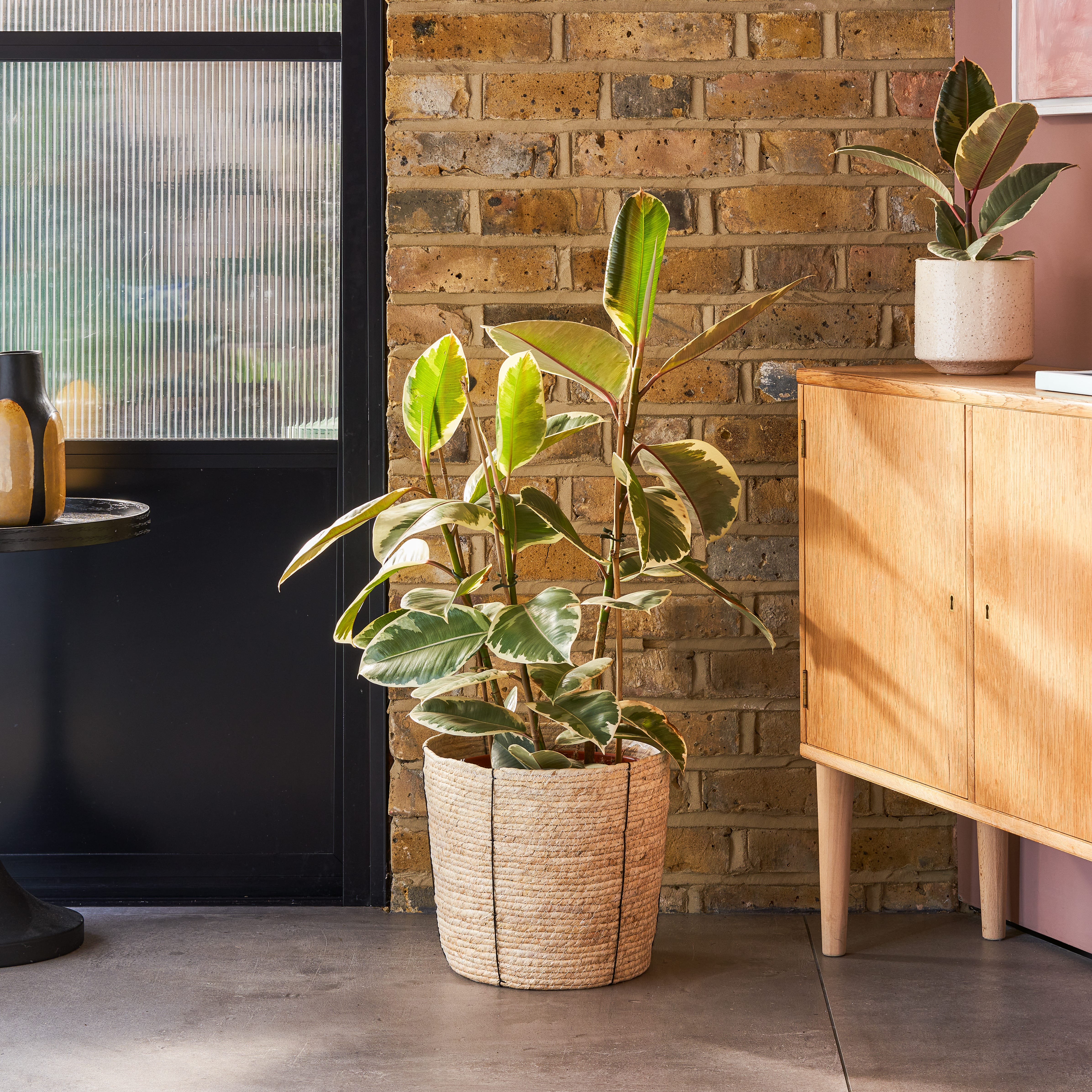
Rubber plants come in a variety of colours and sizes. For ease, ours are called Robin, the standard Ficus elastica ‘Robusta’, and Rob, the variegated version, which has hints of white, pink and pale green across its leaves. Both their botanical and common names make direct reference to one of the most striking features of these impressive plants: the white latex coursing through their veins, which was once used to make rubber. As far back as 1400BC the Mesoamerican people used Rubber plants as a key ingredient to make bouncy balls.
You might also have heard of it referred to as the Banyan tree, the very tree that the Siddhartha, or Buddha, sat under when he gained enlightenment – while we advocate meditation, we can’t guarantee the same result!
This is however where common names get confusing, because while Ficus elastica is not the same species of Fig that promises enlightenment – that is, of course, Ficus religiosa – it is part of the banyan group of figs. What figs in this group have in common is their quirky but clever habit of growing aerial roots (above ground) and buttressing roots from their central trunk. These help them anchor down into the soil. In parts of India these strong flexible aerial roots are trained and plaited together to form ‘living bridges’ over small rivers.
The big picture: from Nepal to north London
Rubber trees are native to a wide range of warm, humid, sub-tropical countries including Indonesia, Myanmar and Malaysia. Similarly if you’ve ever travelled to India or Thailand you’re likely to have seen them ‘in the wild’ – they’re quite the spectacle to behold. In fact, this is the beauty of travel, we get to sweat it out in the muggy air that the houseplants that hail from these countries thrive in. And this tells us exactly what we need to know when we come home to look after our Rob or Robin.
The three key ingredients: humidity, heat and H2O
Let's get steamy . . .
While we don’t all live or work in glasshouses that mimic the subtropical conditions that Rubber plants would thrive in, luckily they’re really tolerant of normal household humidity which is between 30-60% RA. It’s worth noting that new builds are often much better insulated than older properties and humidity-loving plants may struggle in these conditions. Fear not, there are a few things you can do to boost it.
Opening your windows allows for the humidity between the outside and inside to neutralise.
Avoid placing your plants close to heating or air conditioning units.
Position your plants in naturally steamier rooms in your house, like the kitchen or bathroom.
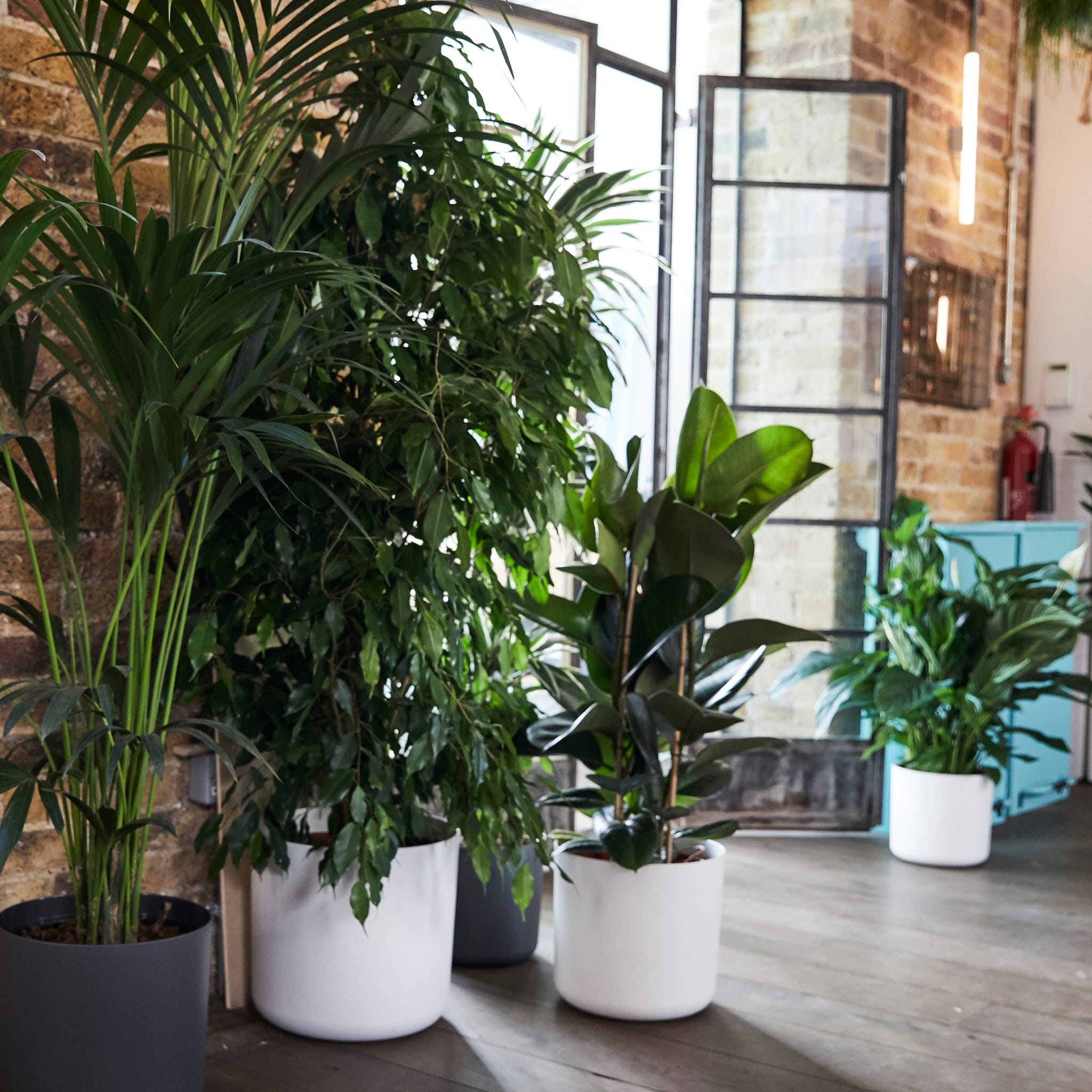
Group your plants together to so that as they transpire they can create their own little microclimate.
Apply a topdress of LECA (lightweight expanded clay aggregate) to the surface of the soil, surrounding the base of your plants. Make sure to wet these when you water, so that they can slowly release water vapour.
Misting only really increases the humidity around your plants for minutes at time, so while it’s not an answer to the problem, if you enjoy it, go for it, and we mean, really go for it, like, multiple times a day!
Some like it hot . . .
Are you dreaming of that holiday in Thailand? So are siblings Rob and Robin. Rubber plants enjoy a consistently warm temperature that doesn’t drop below fifteen degrees, with higher temperatures suiting them just fine. Avoid winter chills by moving them away from doors or windows that could let in cold draughts.
Place them in a bright room that gets plenty of sunlight. A south-facing room is best but even morning or evening light in east or north-facing rooms will do. Too little light and you’ll notice that your plant grows slowly, or that the new growth is weak, thin and ‘leggy’.
A top trick if all of the light is entering your room from one side: rotate your Rubber plant a little at least every two weeks. This will stop it getting a lean on as it grows in search of that sun.
Monsoon rains . . .
Water your Ficus elastica well when the soil is almost completely dry. Dip your finger about three inches into the soil. If your finger comes out mostly clean and dry, it’s time for a drink. If it's moist with lots of soil sticking to it, check back in a couple days. Check more often during the spring and summer to keep your rubber plant hydrated when it’s hot.
Be sure to water the whole root ball until you can see a little bit of water draining through the holes at the bottom of the nursery pot. If there’s a little bit of excess water, your plant should wick it up within a couple of hours, but be careful not to leave it sitting in a swimming pool for fear that the dreaded root rot sets in. A telltale sign of overwatering is when the leaves go soft and turn yellow, brown, or even fall off.
Taming the tree: pruning, pampering and pest control
To keep those large leaves looking green and glossy there are a few simple jobs to get in the habit of. At least once a month from April to October, give your Rubber plant a feed with liquid plant food. When you have a spare moment, use a damp cloth to wipe down Rob’s leaves. Removing any build-up of dust allows him to absorb the maximum amount of light, and breathe freely (absorb CO2 and release O2) through the stomata on the underside of his leaves. You might find that once you start, you can’t stop – it’s a really therapeutic thing to do, for both your Rubber plant, and you.
Next on the list are some slightly more daunting jobs, but fear not, we have your back.
Ready, steady, cut . . .
Under the right conditions Rubber plants grow quite quickly and you might find yours is taking on tree-like proportions. In a lofty apartment with high ceilings they can look quite dramatic, but for many of us, some containment is necessary. Pruning, or cutting back, is best done in early spring when your plant is just starting to come out of dormancy – the fancy term for plants slowing down and not growing very much over winter. There’s two reasons for this. Firstly, pruning in spring gives your Rubber plant the whole of the growing season – April through to October – to recover and put on new growth. And secondly, while you can prune in summer, you’ll find it more messy. As the light levels increase, the sap in your plants starts to quicken its journey up the stems as it grows, and in the case of ‘The Robs’, this means lots of sticky white latex will come flowing out any cuts you make. Either way, it’s good to have a cloth to hand to wipe any excess sap away, and it’s important that you wear gloves to protect your hands because the latex can cause skin irritation.
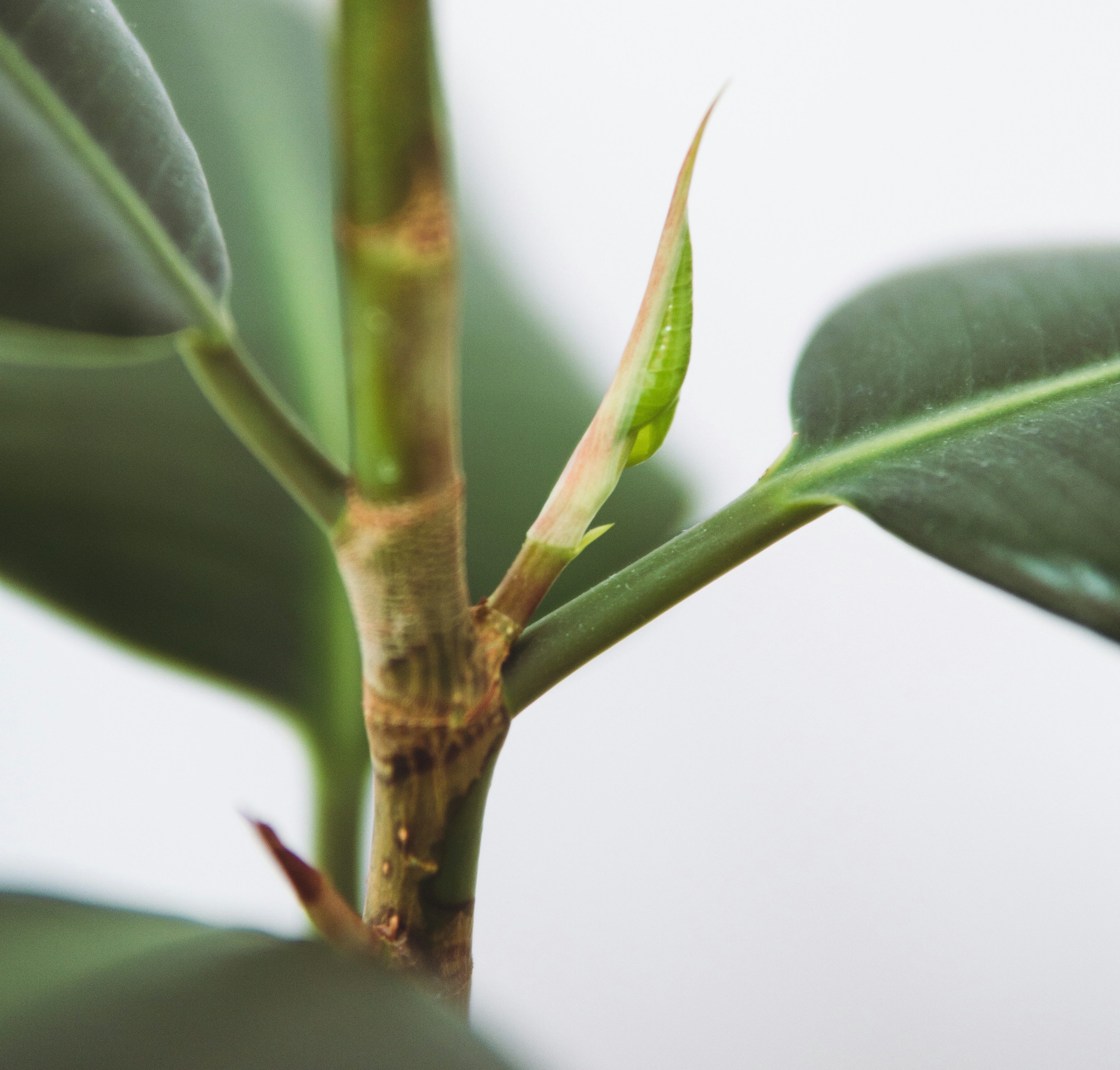
You can prune hard, which means taking a stem right down to the base, or you can simply give your Rubber plant a light trim. Use clean, sharp secateurs and cut just above a node – the points along the stem where leaves emerge from. Keep a close eye, and over the next few months you’ll see a new shoot growing from the node.
Make a notch in it . . .
If your Rubber plant is growing well but is all height and no branches, there’s two clever little tricks you can do to encourage it to grow side shoots.
The first one is cutting the growing tips back by a node or two. Plants have evolved to grow upwards toward the light through a process that has been called ‘apical dominance’. By stopping this upward trajectory you redirect energy back down the stem and this can encourage branching.
The second trick is to decide where along the stem of your Rubber plant you want it to branch out, and using a clean, sharp knife cut a small notch into the stem, just above a node. Cut a 90 degree angle downwards and again upwards until the two points meet, deep enough that you cut through the thick outer layer of the stem into the slightly softer tissue underneath. While it may sound cruel, making a little ‘wound’ or notch like this in your Rubber plant tricks it into sending lots of energy to that point in the stem. It is this energy that over the next few months will grow into a side shoot.
Prevention is better than cure . . .
Because Ficus elastica ‘Robusta’ can be such a fast grower in the right conditions, you’ll need to pay more attention to whether it needs to be repotted than many other houseplants. They don’t mind being a bit rootbound (when the roots have nearly filled the whole nursery pot) but you’ll know that they’re definitely ready for a repot when they stop growing, when you water them but it runs straight through without being absorbed, or when your plant starts to look stressed – telltale signs are yellowing or browning leaves.
Healthy roots mean a happy plant, so by repotting your plant every two to three years as a rule, you’re making sure it has all of the nutrients, air and water that it needs to flourish. Find our step-by-step guide to repotting here.
Last but not least, it’s best practice to keep any potential pests at bay by giving the leaves of your Rubber plant a regular spritz with a natural pest control spray.
Rubber plant care 101
Keep it nice and humid
Nice bright light
Water well when nearly dry
Avoid cold temperatures and draughts
Give it a prune
Repot every 2-3 years
DID YOU KNOW?
Fig tree flowers, Ficus elastica included, are actually on the inside of what we know as the fruit (fig) but what is botanically known as a syconium. These trees have co-evolved with species of wasps that burrow into the ‘fruit’ to fertilise the many tiny flowers on the inside.
Let’s get the conversation going: do you have any questions about your Ficus elastica that we haven’t already answered? Ask us in the thread.