

Come April in the UK and we’re officially heading into spring. It’s not only us that have spent the last few months hankering for warmer days and sunshine, but the plants that we live alongside have been holding tight to their energy. In this article we’ll be running through how your plants change with the arrival of spring, and what you need to do to stay in tune.
The sap is rising, so must you
We take it for granted in the horticultural profession, that people know what we mean when we use phrases like ‘dormancy’ or the ‘growing season’, but every now and again it’s good to be reminded to break it down.
Plants, whether indoor or out, native or exotic, respond to the seasons, and like us, they’ve evolved clever strategies to help them, literally, weather the changes. One of the major seasonal shifts in the northern hemisphere are light levels. As we go into winter and move out into spring, the vegetative world around us responds to changes in day and night length through a process called photoperiodism (periods of light). Physiological responses are similarly triggered by changes in temperature.
Outdoors, where these changes are extreme, some plants lose their leaves while others die back to underground tubers and some start flowering while others surge into full foliar growth. Seeds germinate, buds break, stems lengthen, wood thickens.
In winter, when the days are cold and short, we say that plants enter dormancy.
For many of our indoor plants that are in relatively stable, temperature controlled conditions, this often means growth simply slows or stops altogether as they conserve their energy. This means reduced photosynthesis (the conversion of sunlight, water and CO2 into energy - glucose sugars - and oxygen) and less rapid transpiration (the absorption of water by roots and release of water vapour through stomata - pores - on the undersides of leaves).
It’s for this reason you’ll often find me banging on about reducing watering in winter, not feeding between October and April, and not repotting until spring.
As the days lengthen, light intensity increases and temperatures rise with the arrival of Easter, these processes kick back into gear and we can officially say our houseplants are re-entering their active growth period. Their increased metabolic activities are our cue to step up to the game. They’ve had their rest, and we’ve had ours.
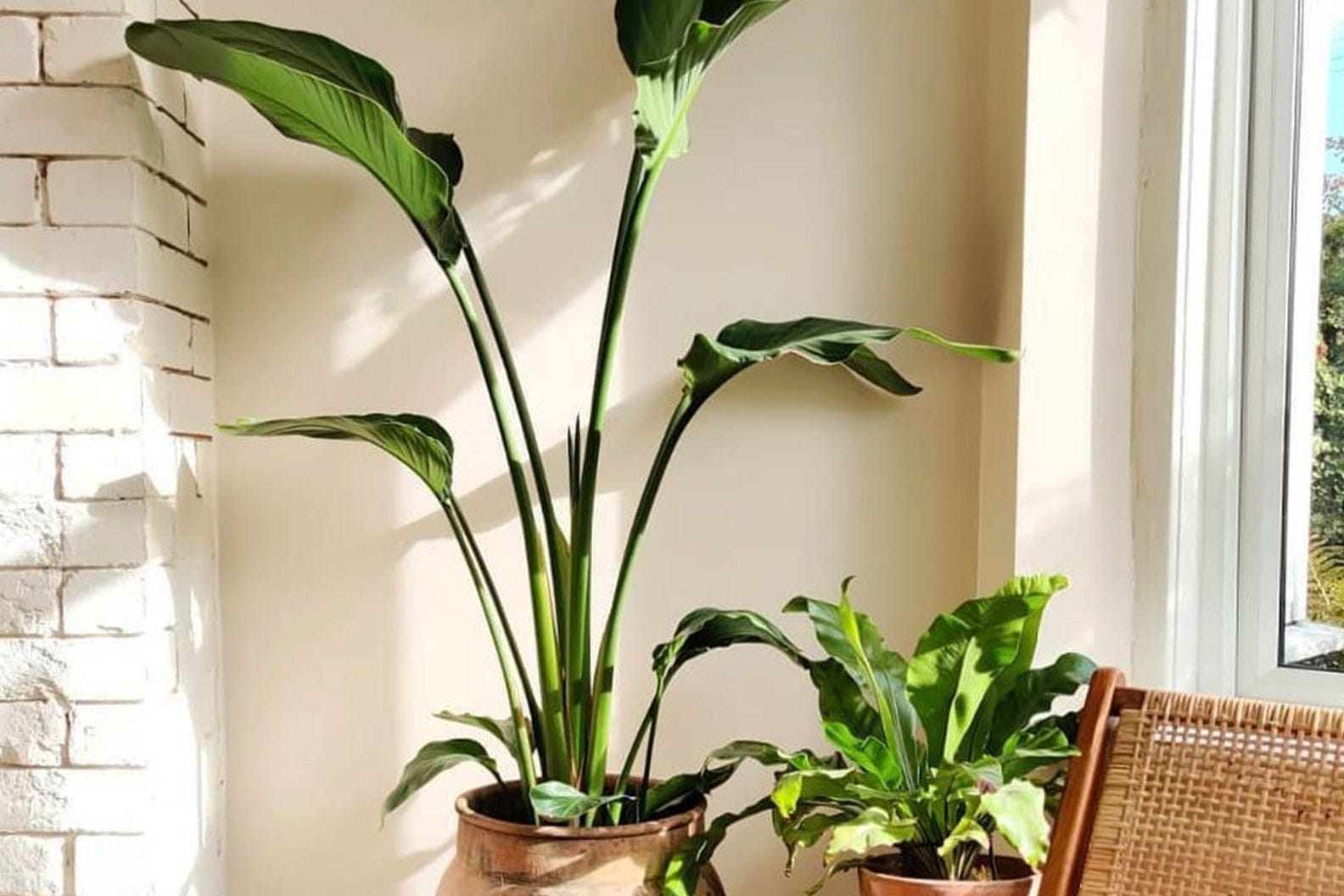
Unlike their outdoor brethren which get washed and watered by rain, fed by sunshine, decaying matter, animal droppings and a far reaching supply of soil into which their roots can grow deeply and freely, growing plants in pots indoors means that they depend on us for many of their basic needs.
So, let’s get into it.
Top it up by a measure or two: Increase watering
We can safely assume that in winter you would have noticed that you weren’t having to water as often and the potting soil was staying moist for longer. As the days brighten, you’ll notice the soil drying out more quickly, and where you may have only had to water once every two-to-three weeks; as we head into summer, watering is likely to increase to once or even twice a week.
To a large extent this depends on how much natural, direct light your home gets, with some rooms no doubt receiving more than others. Plants in a bright south facing room with large windows for instance, will be wicking up much more water than those in a cool, low-lit bathroom or a house with a north facing aspect.
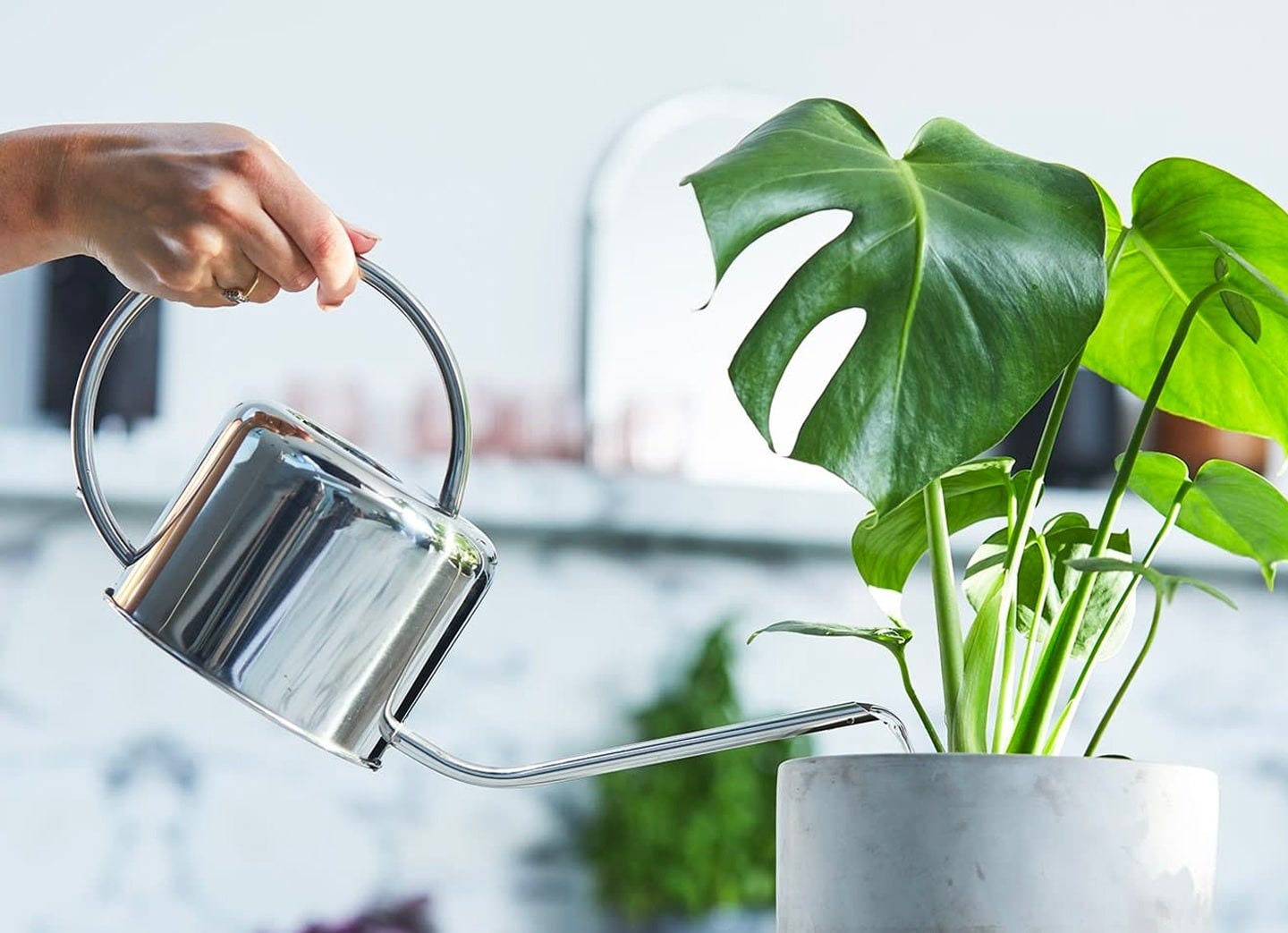
Create a healthy habit of checking the soil moisture at least once a week. And by this we don’t mean the soil surface alone. Doing the finger dip test and assessing moisture to at least two inches below the surface is essential to avoid over watering.
For a detailed guide to watering houseplants, read Watering: Time for a tipple.
Feed it like you mean it: Plant food supplement
Within six months to a year of having bought or potted up a plant, it’s likely to have used most of the nutrients contained in the soil it was potted into, particularly if it’s been in the right growing conditions, getting the light, water and temperatures it needs to put on lots of healthy new growth. From then on, because the roots have nowhere to go in search of nutrients beyond the capacity of the pot they’re, your plant is reliant on you to top it up.
We personally prefer liquid houseplant food, sometimes referred to as a tonic, that you can simply add to your watering can and so kill two birds with one stone, so to speak. While most plant foods aren’t explicit about what’s actually in them, one of their primary constituents is usually seaweed, which contains several of the nutrients plants need to support them. The three main players are nitrogen (N), phosphorus (P) and potassium (K). The NPK ratio in plant foods for indoor plants is generally higher in nitrogen, which is essential in promoting green, foliar growth, rather than phosphorous, which encourages flowering.
For full, leafy plants it’s generally recommended to feed with full-strength fertiliser (1 cap full to a 10 litre can, for instance) every two to four weeks between April and October, when they’re most hungry and using up the most energy to grow. For smaller and slower growing plants like cacti and succulents, half-strength fertiliser should suffice.
Every now and again, it’s good practice to flush any excess nutrients through the soil by removing your plant from its decorative pot and watering it in its nursery pot outside, over the sink or in the bath or shower where water can drain right through. A build up of nutrients – more than your plant actually needs to grow - can have an adverse effect on its health, the first sign of which can look like burned patches on its leaves.
Room to grow: Repotting
While feeding your plant with a plant food substitute will suffice for so long, it’s only a matter of time before only the real deal will do. For this reason, repotting into fresh compost should be done every two-to-three years, regardless of whether your plant has become rootbound or not. For a step-by-step guide to repotting, check out our article Repotting: Feel the fear and do it anyway.
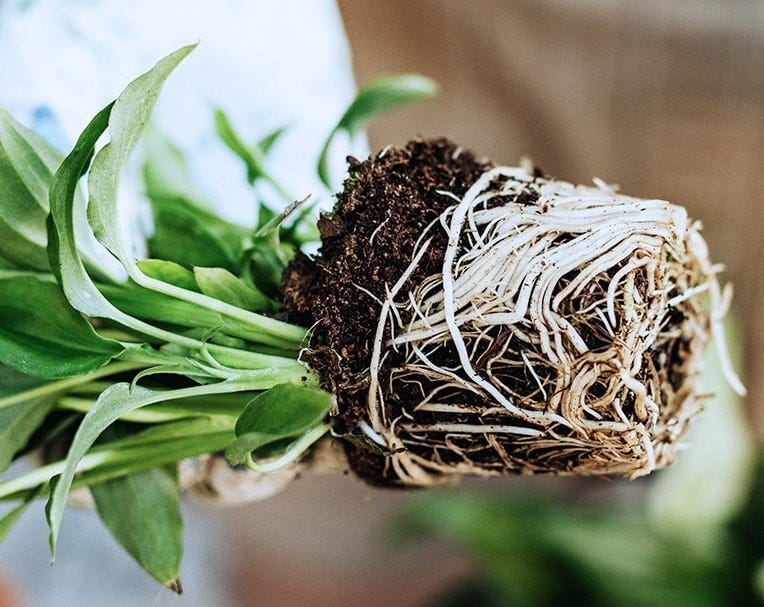
It’s important not only to provide a fresh supply of nutrients but also to ensure good soil structure (moisture retentive but free draining), which is essential for your plants roots to be able to absorb water. If you haven’t repotted for some time, you may well have noticed how the soil level in the pot has dropped. This is because the particles have broken down over time. If you err on the side of irregular watering, you may also have noticed that the soil in the pot has contracted in from the sides, or that when you give your plant a drink, the water runs straight through without being absorbed. These are all signs that repotting is necessary in order to improve the soil structure.
Repotting can be quite stressful for plants, even if it does them good in the long run. One of the main reasons for doing it in spring or summer is so that your plant has the whole growing season to recover, soaking up as much sunshine as possible in order to generate the energy needed to put on new roots and shoots.
The second main reason is to avoid any chance of root rot. Whether your plant is in a bigger pot or you’ve reduced the size of the rootball, it’s going to take some time for new roots to grow into the fresh compost. This means that when you water your plant as normal, the new compost is likely to stay wet for longer, because there are no roots absorbing the moisture from it, for the moment at least. It won’t take long however; the fresh nutrients ‘below ground’ together with the warm temperatures and sunlight ‘above ground’ will soon stimulate new growth.
Keep it in shape: Pruning
Just as repotting is best done in spring in order to give your plants the best chance of ‘recovering’ quickly, so is pruning.
Pruning can mean cutting back any dead (D), dying (D) or diseased (D) stems and leaves, but it can also mean shaping your plant by reducing the length of its stems to maintain or control its size, and opening up its framework to create a strong architectural shape. Watch me do this in the video below, where I’m reducing the amount of smaller and weaker stems of Ficus lyrata and Pachira aquatica to create a strong framework.
Pruning out DDD material is essential to keep your plant healthy, letting in light and air, and removing potential hiding places for pests and fungi. Pruning for shape and structure has the benefit of channeling your plant’s energy into the remaining stems and leaves as well as redirecting its energy away from the growing tips, back down the stems, creating fuller, bushier growth. It can be very useful in regenerating a leggy Pothos that has lost a lot of the leaves along its straggly stems, for instance.
Harness the energy: Propagation
Spring is the time to harness the energy that is pulsing through your plants. And what better way to do this than to increase your plant collection by division, by taking cuttings – whether by stem or leaf, and by separating and potting up offsets. For more information on each of these techniques, check out our comprehensive article all about propagation here.
The growing season is the best time to propagate not only because any wounds made by cutting will heal quickly and any disruption of the rootball will soon stimulate regeneration, but because the light levels and warm temperatures will encourage rapid results in your vulnerable new plants. Sunny windowsills are perfect for rooting cuttings – you’ll literally see root growth within days.
The support they need: Staking and training
One of the greatest love languages you can offer your plants is to anticipate their needs. Given that you know they’re moving into their peak growing season, be prepared to offer them support, whether this be providing your Monstera, Pothos or Philodendron with a moss pole to which they can attach themselves with their aerial roots – climbing being their natural disposition after all – or bamboo canes to which you can gently tie the soft new growth of your Ficus.
Let the light shine in: Leaf wiping and window washing
Given we wait six months for the sun to shine, we want to make the most of those golden rays. Unlike in the wild where, even in the shade of trees the light plants receive is much more direct; in our homes the light is filtered through the glass of windows and the fabric of blinds or curtains. It’s also blocked by surrounding buildings or has to bend at sharp angles around walls and doors.
We can add to light’s challenge the fact that, because our indoor plants stay in one position where they’re not whipped about by wind, washed by rain or brushed by passing animals like they would be in their natural environments, dust quickly builds up on their leaves, creating yet another barrier for light to penetrate.
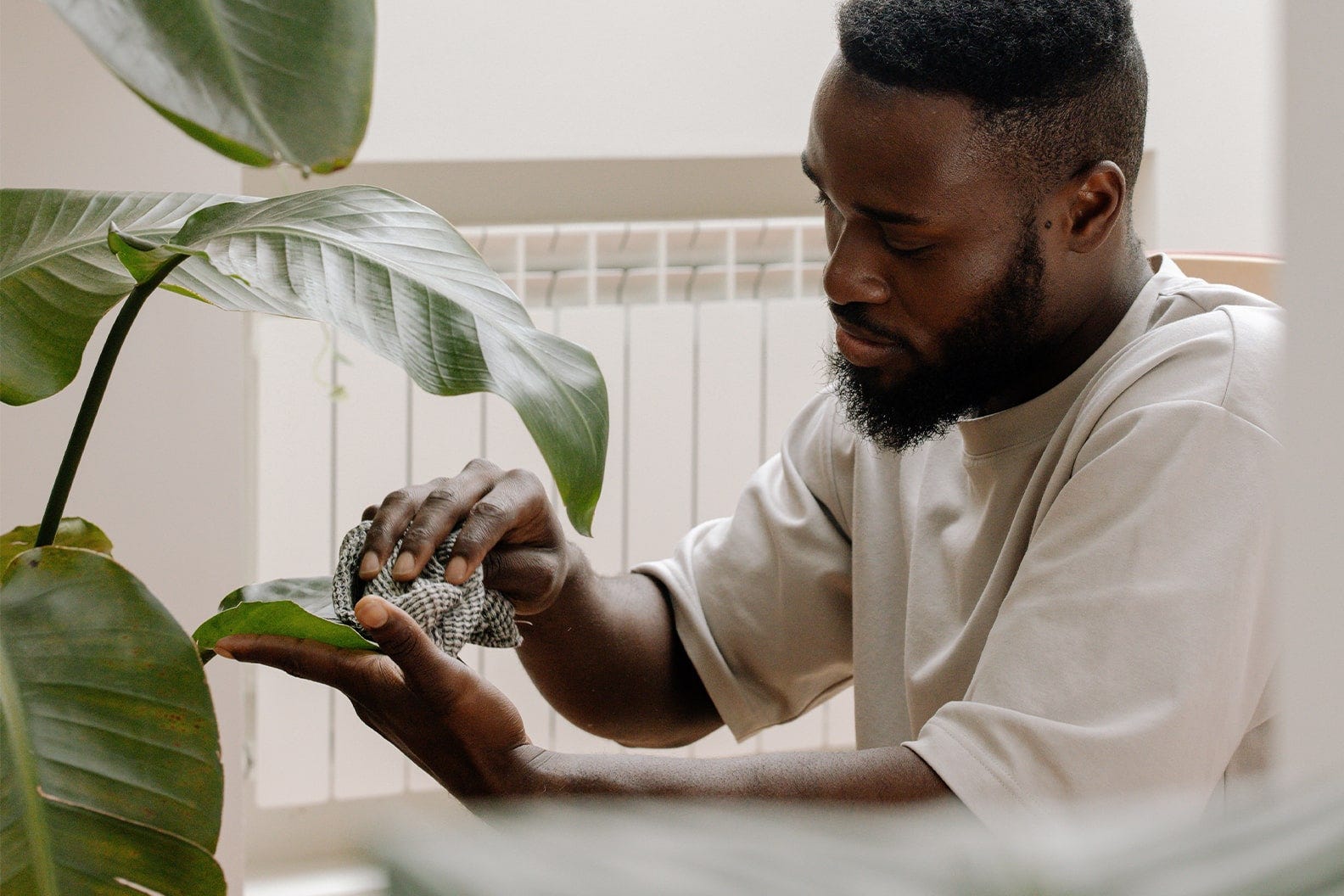
To give your plants a helping hand (you’ll benefit too), give your windows a wash down in spring. And throughout the year, treat your foliar family by either wiping down large, smooth leaved plants with a damp cloth or giving bushier, fine leaves plants a shower under room temperature water.
Prevention’s better than control: Pests
Just as giving the leaves of your plants a wipe down or shower is good for keeping them clean of dust and able to photosynthesise to their heart’s content, so it is helpful for washing away or dislodging any pests that might be lurking.
Pests that are common on houseplants like mealybug, red spider mite and thrips, can often be present, inactive and so invisible, waiting for the perfect conditions of light, temperature and humidity to align, at which point they hatch, start breeding and multiply quickly. This is why it’s important to be ready for them.
There are many bug control sprays, some synthetic incorporating insecticide and some natural. We always suggest the natural approach and would only advocate the latter as an absolute last resort.
Whether you see any signs of pests or not, bug control spray can be applied every few weeks. Not only does it create a thin viscous layer over the leaf surfaces which prevents sap sucking pests from getting their mouthparts in when they want to feed, but it often includes micro-nutrients which, when absorbed by the foliage, help boost your plants immunity to fight against any potential infestations.
Give it a spin: Rotating your plants
Throughout the year, but over the growing season especially, it’s a good idea to get into the habit of turning your plants every couple of weeks. Few of us have our plants in a spot where they receive 360 degrees of light and the likelihood is that yours is in a corner, on a shelf, or up against a wall, where the leaves facing out will be getting a lot more sunlight than those at the back.
By giving them a spin, you ensure that all ‘sides’ of your plant get an even and regular amount of light. One of the benefits of this is that you’ll gain full, even, leafy coverage and a plant that grows straight up and out, rather than one that leans precariously towards the nearest light source or has sparse or bare leaves on one side.
Spring/Summer Checklist:
Increase watering
Start feeding
Repot if necessary
Prune for health and structure
Propagate for fun
Provide support for new stems
Clean windows and leaves
Apply bug control spray
Rotate your plants for even light
Just as we have our own regular health checks throughout the year, and adapt our clothing and cosmetic routines to the seasons, so too do our plants require flexible care. As we embrace spring and head into the summer months, may you feel positively charged to give your home garden the TLC it needs.
Love your articles - so helpful